


게시판
Measurement sensitivity when inclinometer casing is severely twisted
작성자
newgeovan
작성일
2026-02-25 20:41
조회
467
There is a 3Deg twist per Inclinometer Casing 1M, and if it connects 10pcs of @3M, it installs 30 meters per borehole, and the cumulative twist angle is 90deg.
Assuming that 100 mm displacement occurs in the ground, it was calculated how many mm the displacement measured in the case of cumulative 90 deg twisting in the entire 30 meters was calculated.
Displacement (mm) = 100 x sin( π/2)/ π/2 = 63mm

Only approximately 63mm (based on the A-axis) of the actual displacement is measured, representing a 37% loss in measurement data.
Since this value deviates from the allowable error range of an inclinometer by several thousand percent, there is a severe risk of missing critical danger signs in the structure if this data is used for design or safety diagnosis without correction.
Furthermore, the distortion of the displacement direction caused by the casing twist leads to a misidentification of the vulnerable areas where collapse or movement is occurring.
Reality: The ground is shifting in the frontal direction.
Data: The measurements suggest the shift is occurring in a diagonal direction.
Consequently, this can lead to critical decision-making errors, such as applying reinforcement methods or installing cutoff walls in the wrong locations, which compromises overall site safety.
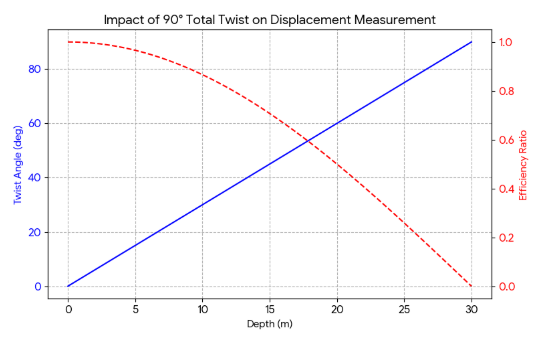
Assuming the casing is uniformly twisted over its 30m length, the cumulative displacement measured across the entire section is equivalent to the integral of the measurements at each point, averaged over the total depth.
To minimize measurement errors, Geovan's high-quality inclinometer casings should be utilized.
Their superior manufacturing standards guarantee a minimal spiral of 0.3° per 3m, ensuring the highest level of directional accuracy.
# Inclinometer Casing Spiral test
# Twist inclinometer casing profile
# Distorted inclinometeric displacement
Assuming that 100 mm displacement occurs in the ground, it was calculated how many mm the displacement measured in the case of cumulative 90 deg twisting in the entire 30 meters was calculated.
Displacement (mm) = 100 x sin( π/2)/ π/2 = 63mm
Only approximately 63mm (based on the A-axis) of the actual displacement is measured, representing a 37% loss in measurement data.
Since this value deviates from the allowable error range of an inclinometer by several thousand percent, there is a severe risk of missing critical danger signs in the structure if this data is used for design or safety diagnosis without correction.
Furthermore, the distortion of the displacement direction caused by the casing twist leads to a misidentification of the vulnerable areas where collapse or movement is occurring.
Reality: The ground is shifting in the frontal direction.
Data: The measurements suggest the shift is occurring in a diagonal direction.
Consequently, this can lead to critical decision-making errors, such as applying reinforcement methods or installing cutoff walls in the wrong locations, which compromises overall site safety.
Assuming the casing is uniformly twisted over its 30m length, the cumulative displacement measured across the entire section is equivalent to the integral of the measurements at each point, averaged over the total depth.
To minimize measurement errors, Geovan's high-quality inclinometer casings should be utilized.
Their superior manufacturing standards guarantee a minimal spiral of 0.3° per 3m, ensuring the highest level of directional accuracy.
# Inclinometer Casing Spiral test
# Twist inclinometer casing profile
# Distorted inclinometeric displacement